
Highlights & trade-offs
Reasons to consider it
- 2700–6800K adjustable white light
- Bowens mounting for familiar modifiers
- Bluetooth Mesh, RF and wired DMX control
- Four selectable cooling modes
What to check
- Compare open-face and reflector output figures correctly
- Confirm Bluetooth Mesh and DMX compatibility
- Check coupon eligibility and bundle contents
Product Review
GVM PRO-SD200B 200W Bi-Color Mesh Bluetooth Monolight
Product overview
The GVM PRO-SD200B is a 200W bi-color continuous LED studio light built for photographers, interview crews and video creators who want a controllable key light. Its warm-to-cool 2700–6800K range helps you match indoor practical lamps or daylight-style scenes. A standard Bowens mount lets you add a compatible softbox, reflector, lantern or grid, which often affects the result more than the headline wattage.
Instead of treating it as a basic on/off lamp, GVM equips the SD200B with onboard controls plus Bluetooth Mesh, RF and DMX/RDM options. That makes it relevant both to a solo YouTube setup and a small studio that needs synchronized lighting. The manufacturer lists the controller and ballast as integrated into the light head; the head weighs 2.7kg, so a suitable stand and the balance of any large modifier should be part of the budget.
Its biggest limitation is straightforward: bi-color does not mean RGB. The SD200B adjusts white-light temperature rather than producing saturated colored backgrounds. And although four cooling modes are listed, quiet audio recording still warrants a real-world microphone check.
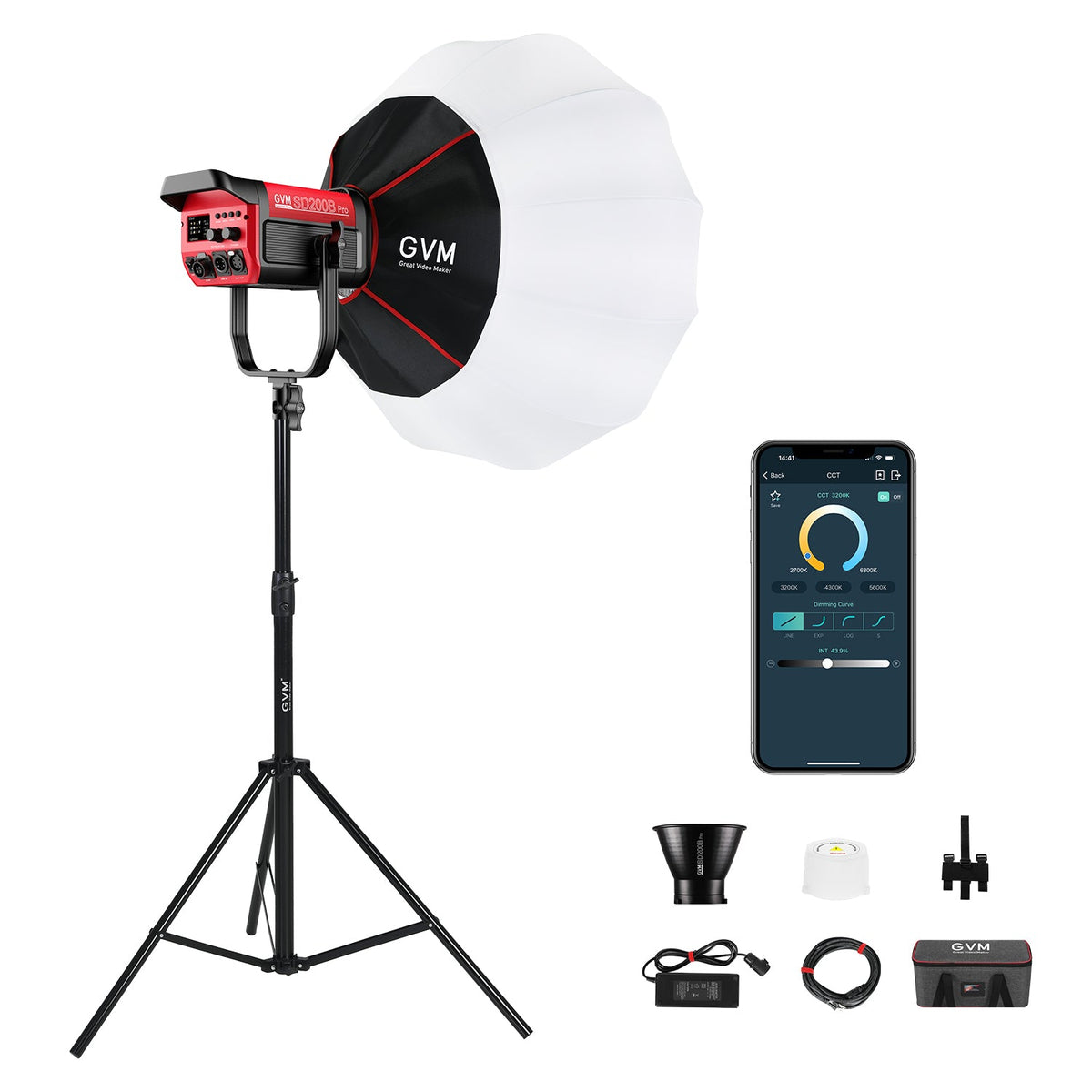
Key Specifications
- Model: GVM-PRO-SD200B
- Power: 200W (manufacturer rating)
- LED: bi-color; 2700–6800K
- Color fidelity: CRI 97+ / TLCI 97 (reported by GVM)
- Output: 8,550 lux at 1m open-face, 45,400 lux at 1m with standard reflector (GVM measurements)
- Dimming: 0–100%, 0.1% steps; described as flicker-free
- Mount: Bowens
- Control: on-board, Bluetooth Mesh, RF, DMX IN/OUT and RDM
- Modes: CCT, Effects and Source Matching
- Cooling: Intelligent, High Speed, Silent and Passive
- Power interface: 32V/7A DC; manufacturer specifies 100–240V AC input for power supply
- Housing: aluminum and engineering plastics
- Dimensions / weight: 292 × 130 × 134 mm/ 2.7kg
Strengths
A wide bi-color range, good published color-accuracy figures, widely used Bowens modifiers, fine brightness control and multiple wireless/wired control methods make the SD200B flexible for interviews, product work and small studio filming.
Trade-offs
There is no full RGB color, the four cooling modes have practical noise and output trade-offs, and lux readings with a reflector do not describe how a diffused softbox looks. Confirm whether your chosen package includes a stand, modifier, reflector and suitable power parts rather than assuming they're bundled.
Buying recommendation
For a creator who needs a single controlled key light, start by checking the SD200B with a suitable Bowens softbox. Buyers who already have lighting support may prefer the bare head; small interview studios may benefit more from a two-head kit. Review live prices, shipping and warranty before checkout.
What Kind of Video Light Is the GVM PRO-SD200B?
Getting a repeatable interview or product shot is less about owning the highest-wattage light and more about controlling where illumination lands. The GVM PRO-SD200B is a 200W bi-color continuous COB-style studio lamp that stays lit while you frame and record. You can watch shadows and reflections move as you reposition it, which is particularly useful when filming yourself or photographing glossy objects.
GVM's published range of 2700K to 6800K lets you warm or cool the light to match the scene. The standard Bowens mount makes it possible to attach a modifier that suits the job. A small studio might use one softbox as its key light; a product setup might use a reflector, flags and a grid to control highlights. Those choices change the final image far more than a generic 'high power' label suggests.
This isn't an all-in-one battery light with every accessory guaranteed. GVM sells different bundles, and the 2.7kg head still needs an appropriate support setup. Check the exact power, stand and modifier contents before comparing package prices.
Brightness: Why 200W and Lux Don't Tell the Whole Story
GVM reports 8,550 lux at 1 meter open-face and 45,400 lux at 1 meter with its standard reflector. It's easy to misread those as two different brightness levels of the bare fixture. The much larger reflector figure comes from concentrating light into a narrower beam. A diffused softbox spreads the illumination, often creating more flattering shadows while reducing the center-point reading.
For a talking-head setup, I'd look first at the distance between the source and the face, the modifier size, and whether the light can fill that diffuser at the camera's preferred aperture and ISO. For shiny products, the shape and size of the reflection are usually more important than a peak lux number. For a window-lit room, the amount of incoming daylight can make a single 200W light feel very different from a darkened studio.
These output figures come from GVM's specifications. TrekReview has not independently measured exposure, beam consistency or color behavior, so they should guide comparison rather than stand in for a controlled test.
Bi-Color Range and Color Accuracy for Skin and Products
The 2700–6800K temperature range makes the PRO-SD200B versatile for warm interiors, neutral product shots and daylight-style interviews. GVM publishes CRI 97+ and TLCI 97 ratings, which are encouraging for a creator who values realistic skin tones and consistent-looking materials. These are manufacturer-reported metrics, not a guarantee that every camera will render colors identically.
One distinction matters if you're choosing this for a streaming room or music video: this model is bi-color, not RGB. It can move between warmer and cooler white light, but it cannot create saturated blue, red or purple backgrounds the way an RGB fixture can. Choose an RGB-capable GVM model if creative colored effects are central to your work.
The product lists 0–100% dimming in 0.1% increments. Fine adjustment is useful when matching a key light to a weaker fill or when making subtle exposure changes across repeated takes. Confirm the desired flicker behavior at your own shutter speed and frame rate before filming a paid production.
Controls: Built-In, Bluetooth Mesh, RF and DMX
Good lighting controls save time when the light is mounted above eye level or beyond your reach. GVM specifies onboard controls, Bluetooth Mesh, RF radio-frequency operation, DMX in/out and RDM. For an individual creator, using the app can reduce the need to leave the camera position. Bluetooth Mesh also offers potential group control for compatible lights that support GVM's system.
For more structured production, DMX is the interesting part: it offers a way to coordinate lighting cues from a controller instead of adjusting each lamp separately. That may be irrelevant in a single-camera home studio but valuable in a room with several fixtures and repeatable scene setups.
Don't confuse a long list of control methods with automatic compatibility across brands. Confirm the current GVM app, any required RF handset, and the exact networking and DMX needs of your gear. The best control method is the one that reliably works within your actual setup.
Cooling and Audio: Four Modes, but Test the Room
GVM lists Intelligent, High Speed, Silent and Passive cooling modes. That's welcome on a relatively powerful COB light because fan behavior can interfere with close microphone placement. Someone recording a voiceover or quiet sit-down interview has different priorities than a crew shooting a fast-moving product demonstration.
However, a mode called 'Silent' should not be mistaken for a published zero-decibel measurement. Likewise, don't assume Passive mode is intended to run at unrestricted full power indefinitely. Ask about any output or thermal limitations, and record a short sound check with the microphone where it will sit during the session.
GVM describes long-duration stability testing, but this review hasn't measured cooling noise or sustained output. Audio-sensitive creators should weigh that uncertainty alongside the attractive brightness and color specifications.
Product-page rating
Rating recorded from the merchant’s product page. Open the source for current customer feedback.
Buying Notes
Prioritize the right modifier, stable support and a compatible power arrangement over wattage alone. Confirm delivery, return and warranty conditions and test any applied discount at checkout.
Bowens Mount and the Real Cost of a Working Kit
The Bowens mount is a strong practical reason to consider the SD200B. A softbox turns a hard source into a broader key light; a compatible lantern can fill a room; a reflector provides a more direct beam; and a grid helps keep spill off the background. This means the same head can serve different shooting styles, provided the modifier is compatible and the stand supports the total weight.
The trade-off is that the head alone does not equal a complete lighting setup. When comparing offers, ask exactly what is included: reflector, softbox, stand, power supply, battery accessories and carrying case. GVM offers individual heads as well as listings with softboxes and multiple lights. Price comparisons are misleading when the package contents differ.
Large modifiers act like sails on a light stand. Even indoors, use the correct support hardware and consider sandbags for stability. It's worth spending on safety and light shaping rather than buying a more powerful head with inadequate mounting equipment.
Compare Options: One Monolight, a Softbox Bundle or Two Lights?
Single PRO-SD200B — best when you own modifiers already. If you have a compatible Bowens softbox and a reliable stand, one head may be the most economical way to upgrade. Confirm what power parts and reflector are supplied in the chosen listing.
PRO-SD200B with softbox — best for a first proper key light. A softbox bundle can be more useful for interview and creator work than a bare lamp. Check dimensions and whether it actually includes a stand; similarly named offers may differ.
PRO-SD200B two-light kit — best for repeatable key-and-fill setups. Two matching heads make sense for small studios filming interviews or multiple products with consistent lighting. But the second light means more stands, setup time and storage, so it isn't automatically a better buy.
GVM RGB alternatives — best for saturated colored effects. If you need colored backgrounds or full RGB creative scenes, compare GVM's RGB-capable fixtures instead of expecting that from a bi-color SD200B.
Choose according to the shots you record every week, not simply the number of pieces in the box.
GVM Coupons, Delivery and Return Considerations
TrekReview's GVM Store lists the MONPARK-GVM code as a 5% offer and separately records an up-to-40% headline deal. These are store listings, not evidence that either saving will apply to every SD200B package. Apply any code to an eligible cart and confirm the final price before paying. Do not assume discounts can be stacked.
GVM publishes return and warranty information on its site, with conditions that may differ depending on the issue and purchase channel. Check the current policy for your country, along with shipping charges and delivery dates, especially if you need the lamp for a scheduled production.
Shipping, returns & warranty
Shipping Delivery Standard Free shipping in within most of the 48 contiguous states.Read full policy ↗
Non-Returnable Conditions Products are generally not eligible for return after 30 days from delivery.
Approved refunds will generally be issued to the original payment method.Read full policy ↗
Within 12 months Failure caused by misuse or customer-caused damage Yes Yes Subject to the repair arrangement Customer may be responsible for one-way or round-trip shipping.
For one year from the date of delivery, if your product develops a fault during normal use, repairs and replacement parts are provided free of charge.Read full policy ↗
Final Verdict
The PRO-SD200B is a practical option for a modifier-friendly 200W bi-color key light. Bowens compatibility and multiple controls stand out; plan for softbox and stand costs and don't expect RGB colors.
FAQ
Is the GVM PRO-SD200B good for interviews or YouTube videos?
Its 200W bi-color engine and Bowens modifier mount make it a credible key-light option for controlled indoor shooting. A suitable softbox, stable stand and quiet microphone placement are important. We have not performed hands-on testing.
What is the PRO-SD200B color temperature range?
GVM specifies 2700–6800K, allowing adjustable warm-to-cool white light. It is not a full RGB fixture.
What are the published brightness and color accuracy figures?
GVM lists 8,550 lux at 1 meter open-face and 45,400 lux at 1 meter using a standard reflector, with CRI 97+ and TLCI 97. These are manufacturer figures, not independently verified test results.
Can I use Bowens softboxes with the GVM PRO-SD200B?
GVM lists a standard Bowens mount, but check the particular modifier's fit, weight, and stand support. Not every package includes a softbox.
Is the GVM PRO-SD200B fanless or silent?
GVM lists Intelligent, High Speed, Silent and Passive cooling modes. We have not measured its audio noise, and quiet mode labels do not guarantee silence or unrestricted output.
Should I buy one GVM PRO-SD200B or a two-light kit?
One head fits creators who already have modifiers and need a single key light. A softbox bundle may suit a first-time setup. Two lights make more sense when repeatable key-and-fill or multi-subject lighting is needed.
How We Researched
GVM manufacturer specification and package-listing review, November 20, 2026. All claimed output and color figures are retailer-provided; no independent lab or hands-on tests were conducted.