
What Stands Out
Torque-sensor assistance is listed across the selected models
Models differ significantly in braking, tire width and folding design
Rider fit and bike weight are essential decision factors
What to Check
Verify weight and ability to move or store the bike
Confirm destination, variant, stock and final checkout pricing
Read the returns fee and model-specific warranty terms
Product Review
1. ENGWE P275 SE
Product overview
Compared with the fat-tire and full-suspension alternatives here, its 24 kg listed weight is relatively manageable, though still heavy compared with an unassisted bicycle. The upright-oriented geometry, chain guard and fenders suit practical everyday use. The main compromise is that it does not fold or offer the bulkier suspension setup of the L20 or E26.
Before buying: check the 155–185 cm listed rider-fit range, your stair/lift situation and the specific color's availability in your country. The maximum advertised range is not a promise for all assist levels.
Best for: regular paved-road commutes, errands and riders who prefer a traditional city-bike shape. The P275 SE has a 250 W hub motor with torque sensing, 27.5 × 1.95-inch tires, Shimano 7-speed gearing and 160 mm hydraulic disc brakes. Its removable 36 V 13 Ah battery is rated for up to 100 km in the lowest assist setting.

2. ENGWE EP-2 Boost
Product overview
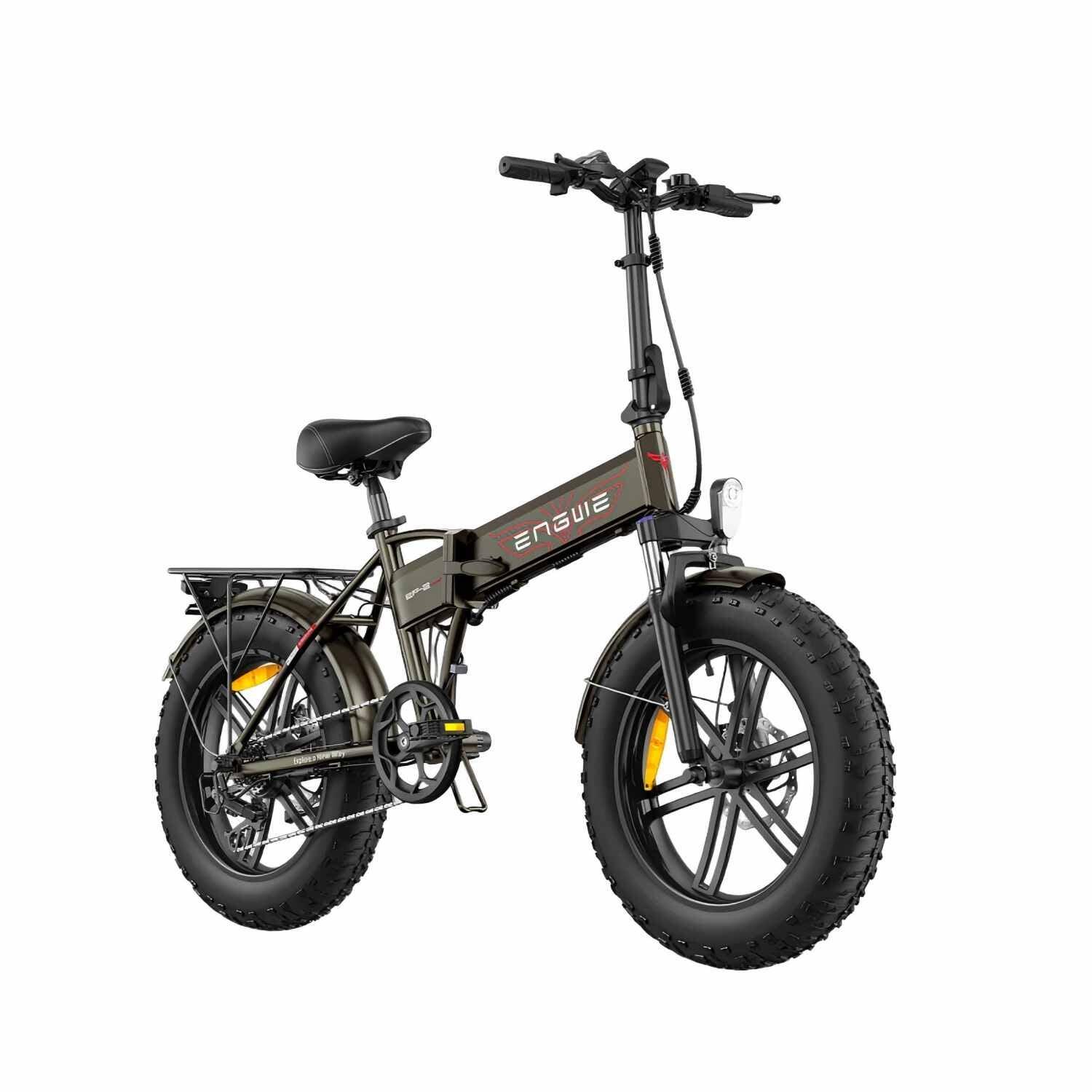
Its wide tires can make this model an appealing choice for varied surfaces and imperfect urban roads. The trade-offs are clear on the spec sheet: about 30 kg of bike weight, a substantial folded package and mechanical rather than hydraulic disc brakes. Those details matter more than the word “folding” if you must carry the bike onto public transit or upstairs.
Before buying: confirm the folded size (listed as 99 × 55 × 75 cm), storage clearance, preferred braking setup and intended route. Compare the exact model variant rather than assuming every ENGWE folding bike has the same motor or suspension.
Best for: riders who want wide tires and a frame that folds for storage. The EP-2 Boost uses 20 × 4.0-inch fat tires, a 250 W motor, torque sensor and a boost function; ENGWE lists a 48 V 13 Ah removable battery and up to 120 km at PAS 1.
3. ENGWE L20 3.0 Boost
Product overview
The fuller suspension arrangement and upright access make sense for uneven commuting surfaces. But the cost of that equipment is bulk: ENGWE lists the bike at 33.2 kg. The advertised 135 km figure is a lab-tested maximum; the merchant's listed assist-specific figures range from 120 km at PAS 1 to 85 km at PAS 5.
Before buying: decide where the bike will live, who will lift it and whether the step-through fit works for your height. Check the chosen variant and any bundled accessories rather than assuming gifts are permanent.
Best for: riders who value a step-through frame, a more cushioned ride and a folding design for storage. The L20 3.0 Boost pairs 20 × 3.0-inch tires with front and rear suspension, a torque sensor, a 75 Nm boost system and hydraulic disc brakes. Its removable 48 V 13.5 Ah battery is listed at 648 Wh.

4. ENGWE E26 3.0 Pro
Product overview
The mid-drive arrangement is the clearest reason to consider it over the hub-drive alternatives, especially for riders who value responsive pedaling support on varied gradients. It is not a compact commuter substitute: the listed weight is 34 kg with battery, it does not fold and it takes more storage room.
Before buying: verify the 163–193 cm rider-height guidance, local repair support and delivery lead time. The merchant currently describes this model as pre-sale, so the availability shown at checkout matters.
Best for: buyers seeking a more capable, non-folding e-bike for mixed paved and gravel routes. The E26 3.0 Pro is built around a 250 W Mivice mid-drive unit rated at up to 100 Nm, a torque sensor, a 720 Wh (48 V 15 Ah) LG battery and 26 × 3.0-inch all-road tires. It also lists full suspension, hydraulic disc brakes and Shimano 8-speed gearing.

Buying Notes
Compare Options
| Model | Best match | Key consideration |
|---|---|---|
| P275 SE | Everyday paved-road commuting | 24 kg, 27.5-inch city tires; not designed to fold |
| EP-2 Boost | Folding storage and wide-tire versatility | 30 kg; mechanical disc brakes |
| L20 3.0 Boost | Step-through riding and bumpy urban routes | 33.2 kg with full suspension; plan for heavy lifting |
| E26 3.0 Pro | Mixed-terrain riding and mid-drive assistance | 34 kg, non-folding; check pre-sale timing |
Match the bike to your daily constraints. If you carry a bicycle upstairs, weight may matter more than folding. If most rides are on paved roads, a city tire and practical fit may beat an oversized fat-tire setup. If you frequently ride on rougher paved or gravel paths, suspension, tire volume and brake type deserve closer attention.
Check sizing and running costs. ENGWE lists a rider-height range for each model; measure your inseam and compare standover, saddle adjustment and handlebar reach. Account for bike weight, charging space, a suitable lock, replacement parts and a workshop willing to service your model.
Check the exact checkout. Price, color, availability and promotions can vary by country. ENGWE EU's published shipping policy lists free DPD delivery to specified destinations while alternatives can carry fees. The return policy gives a 30-day request window but sets condition limits and a €200 fee for non-quality-related e-bike returns. Review the product-specific warranty and delivery terms before ordering.
Final Verdict
Choose P275 SE for straightforward urban use, EP-2 Boost if folding and fat tires matter, L20 3.0 Boost for step-through full suspension, or E26 3.0 Pro for mid-drive mixed-terrain capability. None is especially light to carry.
FAQ
Which ENGWE EU model is the easiest to manage for daily city riding?
Among these four, the P275 SE has the lowest listed bike weight (24 kg) and conventional 27.5-inch city tires. It is a sensible starting point for paved-road commuters, provided its frame dimensions suit you. It is not a folding bike.
Does folding make the EP-2 Boost or L20 3.0 Boost easy to carry?
Not necessarily. ENGWE lists the EP-2 Boost at approximately 30 kg and the L20 3.0 Boost at 33.2 kg. Folding can help with storage footprint, but lifting either bike may still be difficult.
How reliable are the advertised range figures?
Treat them as stated test-condition estimates, not guaranteed commuting distances. Assist level, route elevation, tire pressure, rider weight, temperature and stops can materially change range.
How We Researched
We compared the current ENGWE EU homepage, four model pages and the merchant's shipping, returns and warranty policies. Specifications, prices and availability are merchant-reported; we did not independently ride, weigh, range-test or verify checkout acceptance of promotional codes. Details may change with country, model version and stock.